CORE DEFINITION & PRINCIPLE
TEXT VERSION
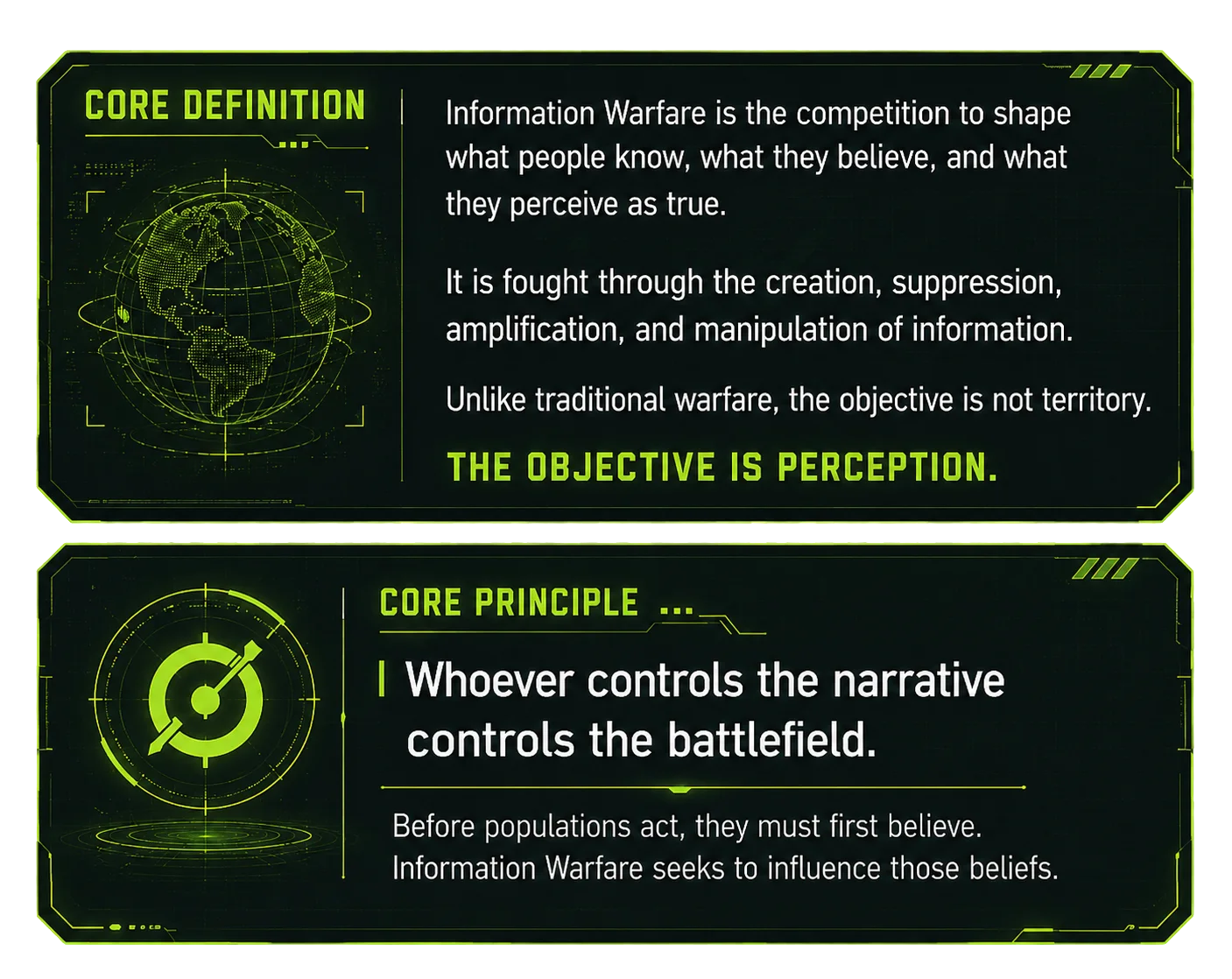
CORE DEFINITION
Information Warfare is the competition to shape what people know, what they believe, and what they perceive as true.
It is fought through the creation, suppression, amplification, and manipulation of information.
Unlike traditional warfare, the objective is not territory. The objective is perception.
CORE PRINCIPLE
“Whoever controls the narrative controls the battlefield.”
Before populations act, they must first believe. Information Warfare seeks to influence those beliefs.
PRIMARY METHODS
TEXT VERSION
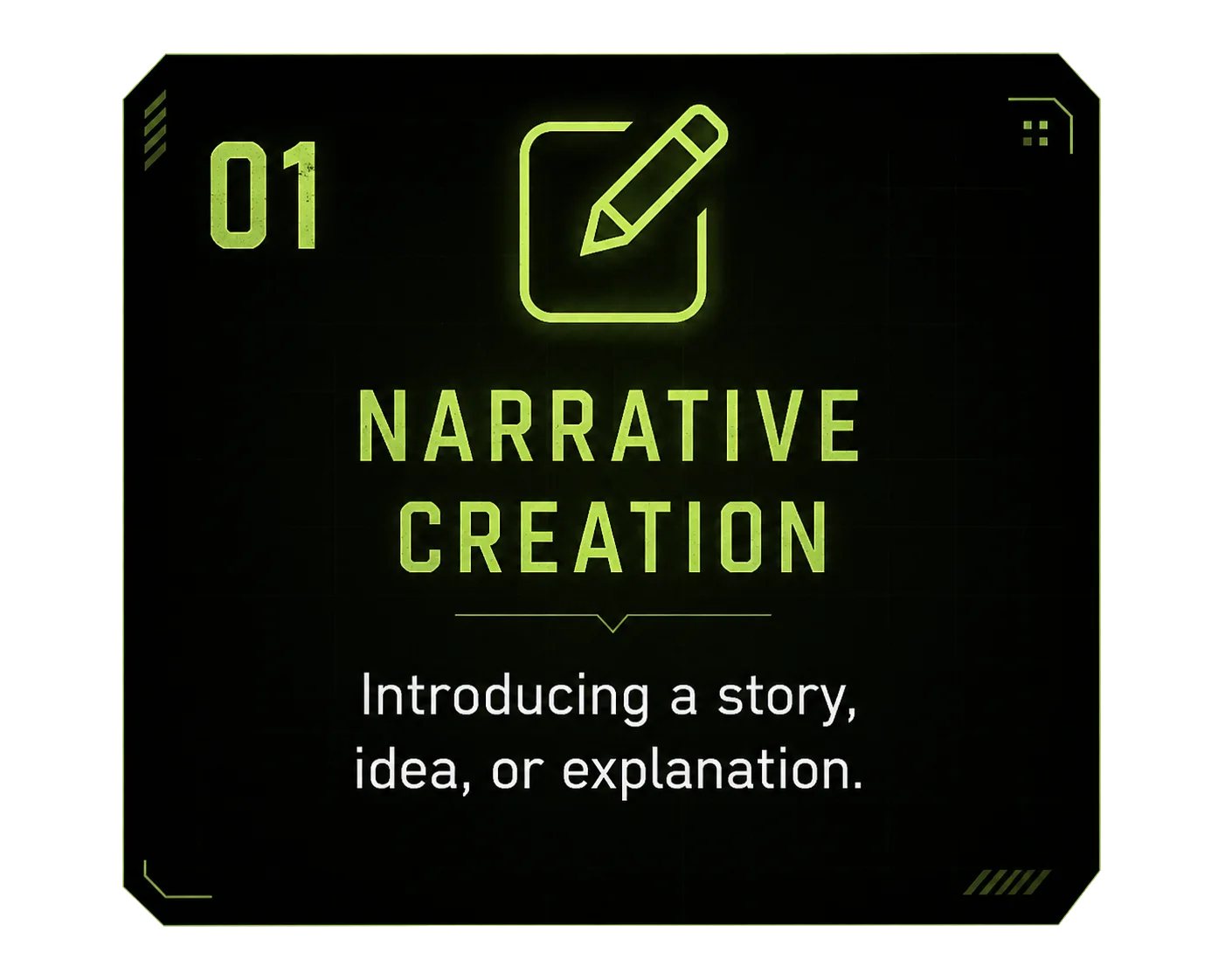
- 01 Narrative Creation — Introducing a story, idea, or explanation.
- 02 Narrative Amplification — Increasing visibility through media, influencers, institutions, algorithms, and social sharing.
- 03 Narrative Suppression — Reducing visibility of competing or dissenting information.
- 04 Narrative Synchronization — Multiple sources delivering the same message simultaneously.
- 05 Narrative Replacement — Changing public attention from one story or issue to another.
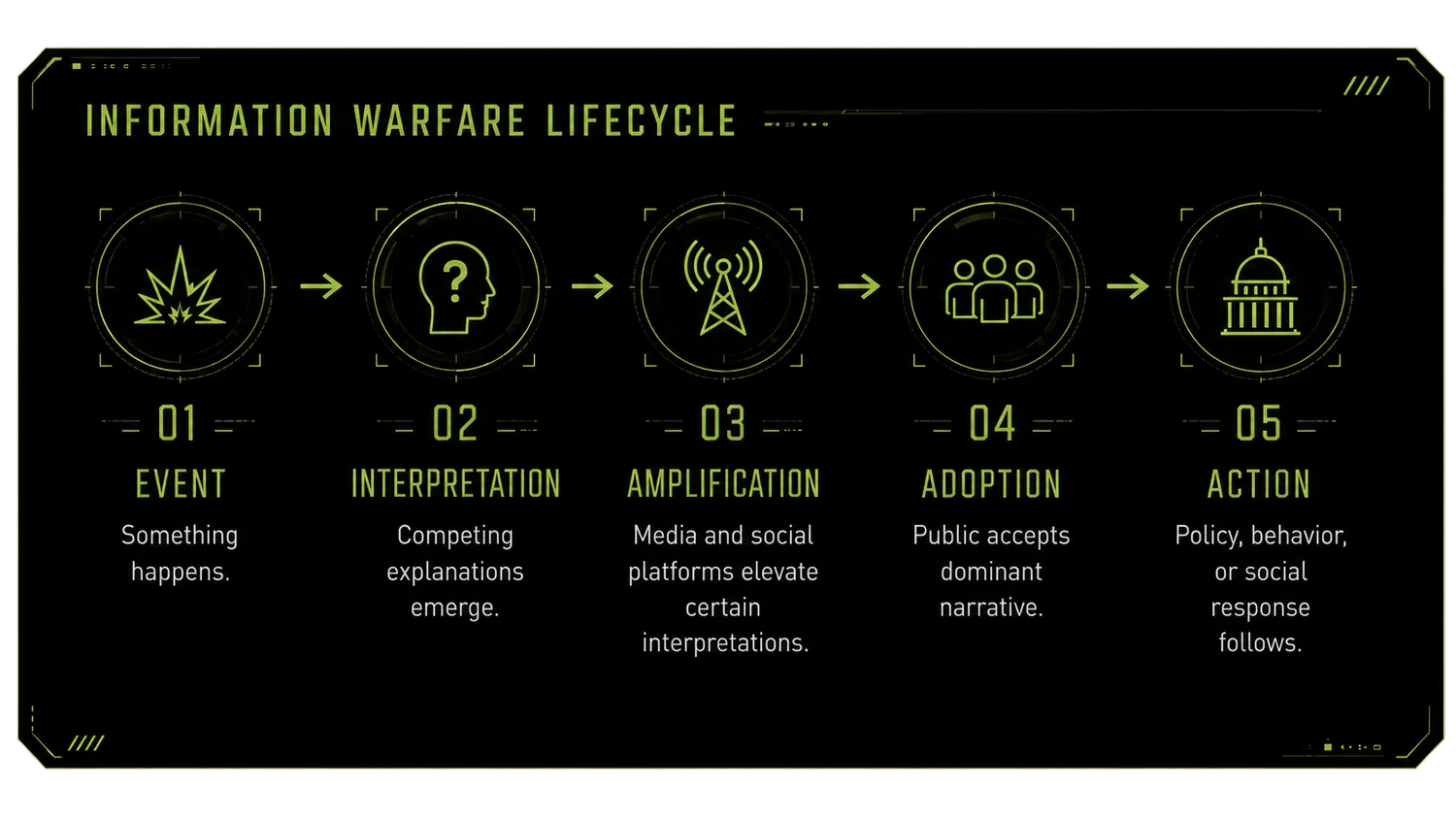
INFORMATION WARFARE LIFECYCLE
TEXT VERSION
- 01 Event — Something happens.
- 02 Interpretation — Competing explanations emerge.
- 03 Amplification — Media and social platforms elevate certain interpretations.
- 04 Adoption — Public accepts dominant narrative.
- 05 Action — Policy, behavior, or social response follows.
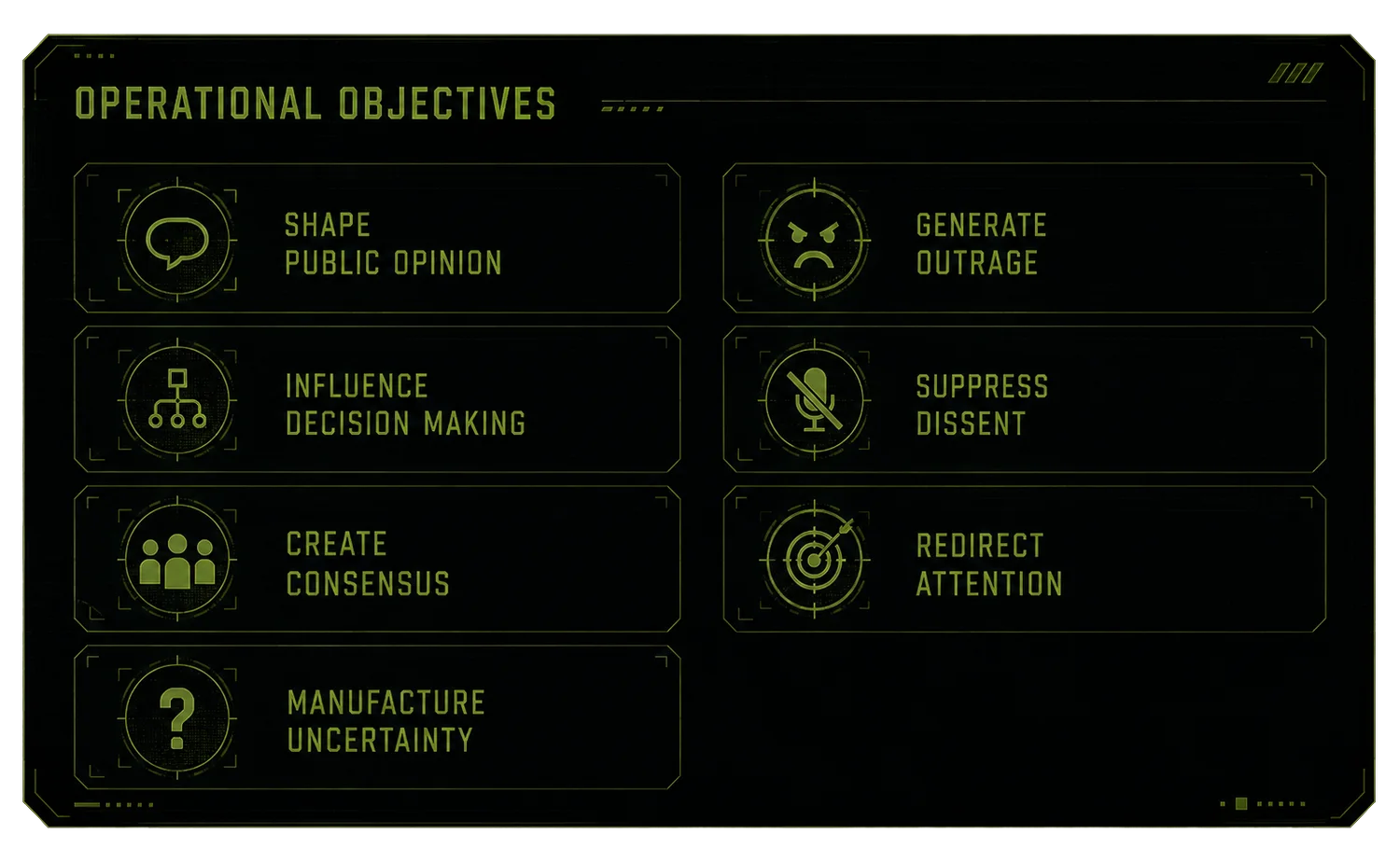
OPERATIONAL OBJECTIVES
TEXT VERSION
- Shape public opinion
- Generate outrage
- Influence decision making
- Suppress dissent
- Create consensus
- Redirect attention
- Manufacture uncertainty
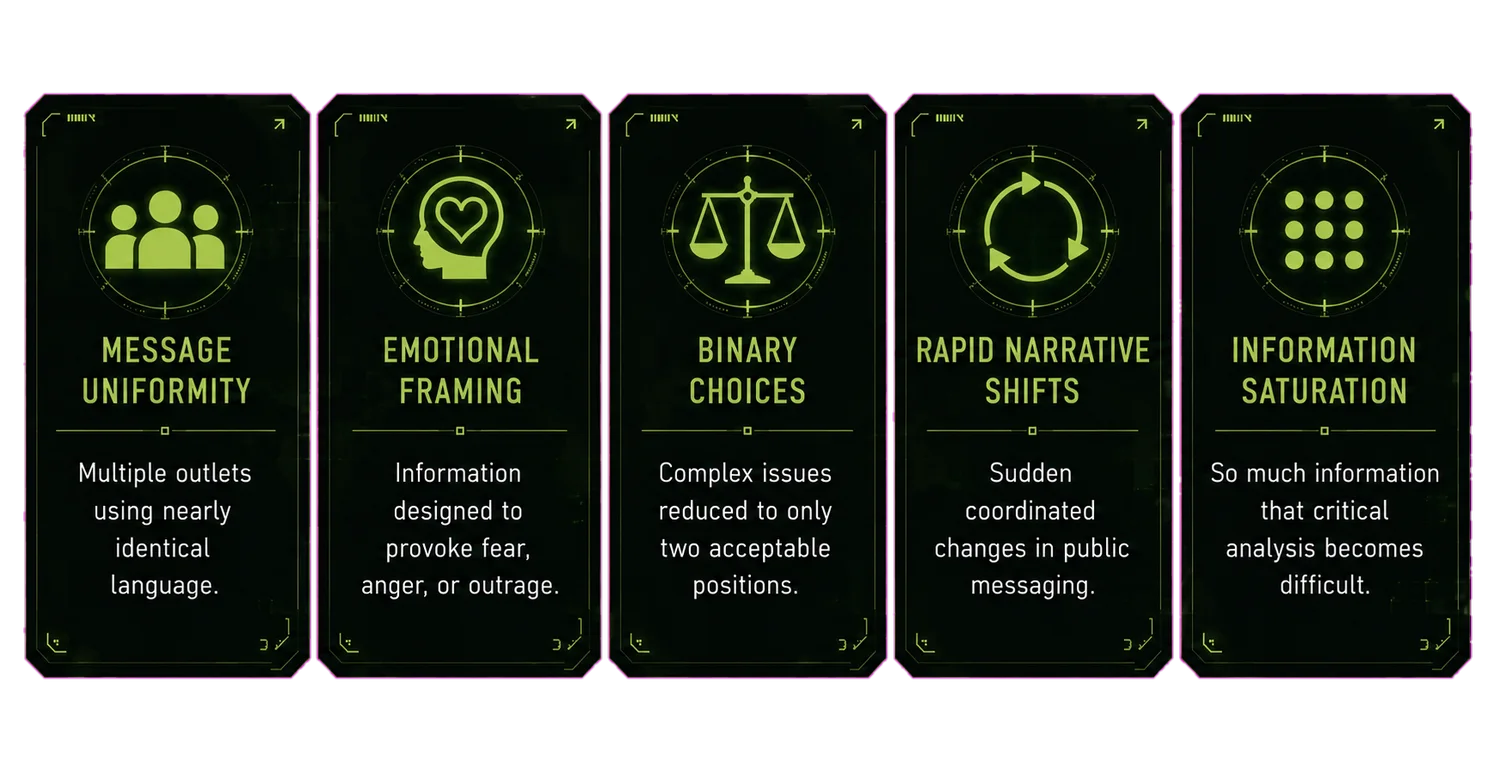
RECOGNITION INDICATORS
TEXT VERSION
- Message uniformity — Multiple outlets using nearly identical language.
- Emotional framing — Information designed to provoke fear, anger, or outrage.
- Binary choices — Complex issues reduced to only two acceptable positions.
- Rapid narrative shifts — Sudden coordinated changes in public messaging.
- Information saturation — So much information that critical analysis becomes difficult.
CASE STUDIES
TEXT VERSION
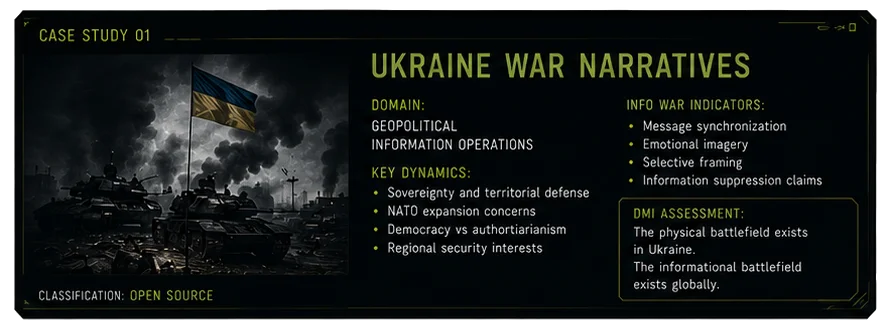
01 · UKRAINE WAR NARRATIVES (open source)
Domain: Geopolitical Information Operations. Key dynamics: sovereignty and territorial defense; NATO expansion concerns; democracy vs authoritarianism; regional security interests. Indicators: message synchronization; emotional imagery; selective framing; information suppression claims.
DMI assessment: The physical battlefield exists in Ukraine. The informational battlefield exists globally.
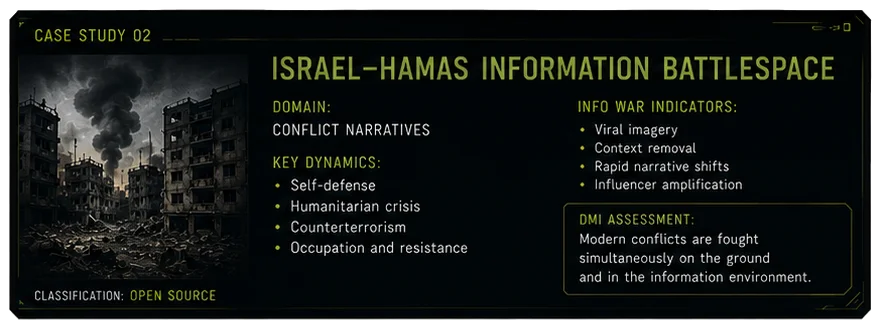
02 · ISRAEL–HAMAS INFORMATION BATTLESPACE (open source)
Domain: Conflict Narratives. Key dynamics: self-defense; humanitarian crisis; counterterrorism; occupation and resistance. Indicators: viral imagery; context removal; rapid narrative shifts; influencer amplification.
DMI assessment: Modern conflicts are fought simultaneously on the ground and in the information environment.
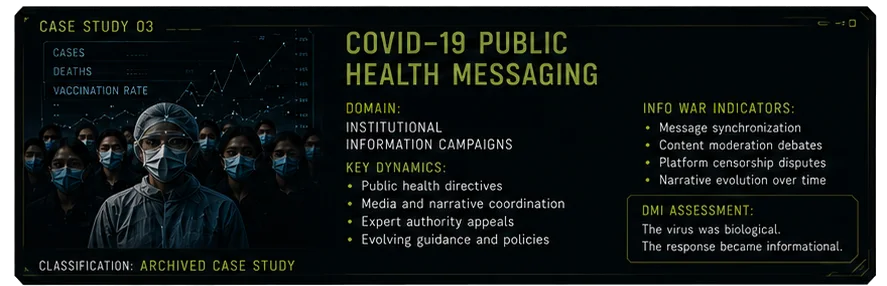
03 · COVID-19 PUBLIC HEALTH MESSAGING (archived)
Domain: Institutional Information Campaigns. Key dynamics: public health directives; media and narrative coordination; expert authority appeals; evolving guidance and policies. Indicators: message synchronization; content moderation debates; platform censorship disputes; narrative evolution over time.
DMI assessment: The virus was biological. The response became informational.
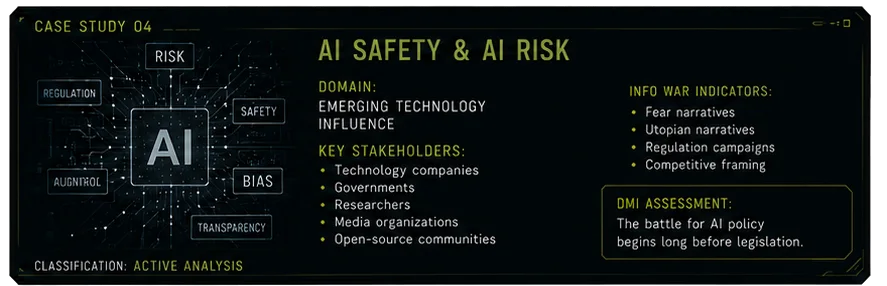
04 · AI SAFETY & AI RISK (active analysis)
Domain: Emerging Technology Influence. Key stakeholders: technology companies; governments; researchers; media organizations; open-source communities. Indicators: fear narratives; utopian narratives; regulation campaigns; competitive framing.
DMI assessment: The battle for AI policy begins long before legislation.
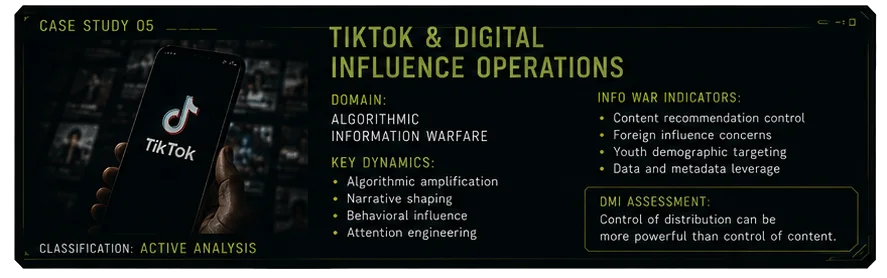
05 · TIKTOK & DIGITAL INFLUENCE OPERATIONS (active analysis)
Domain: Algorithmic Information Warfare. Key dynamics: algorithmic amplification; narrative shaping; behavioral influence; attention engineering. Indicators: content recommendation control; foreign influence concerns; youth demographic targeting; data and metadata leverage.
DMI assessment: Control of distribution can be more powerful than control of content.
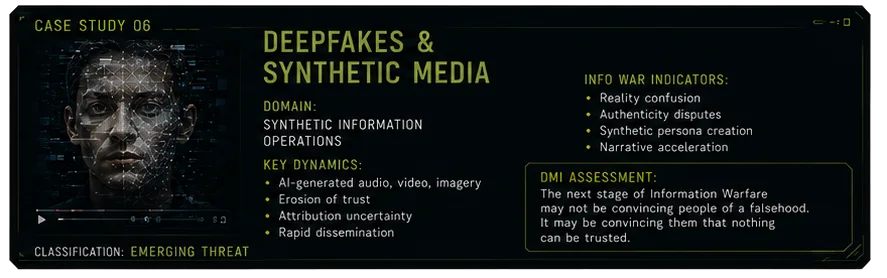
06 · DEEPFAKES & SYNTHETIC MEDIA (emerging threat)
Domain: Synthetic Information Operations. Key dynamics: AI-generated audio, video, imagery; erosion of trust; attribution uncertainty; rapid dissemination. Indicators: reality confusion; authenticity disputes; synthetic persona creation; narrative acceleration.
DMI assessment: The next stage of Information Warfare may not be convincing people of a falsehood. It may be convincing them that nothing can be trusted.
FIELD QUESTIONS
TEXT VERSION
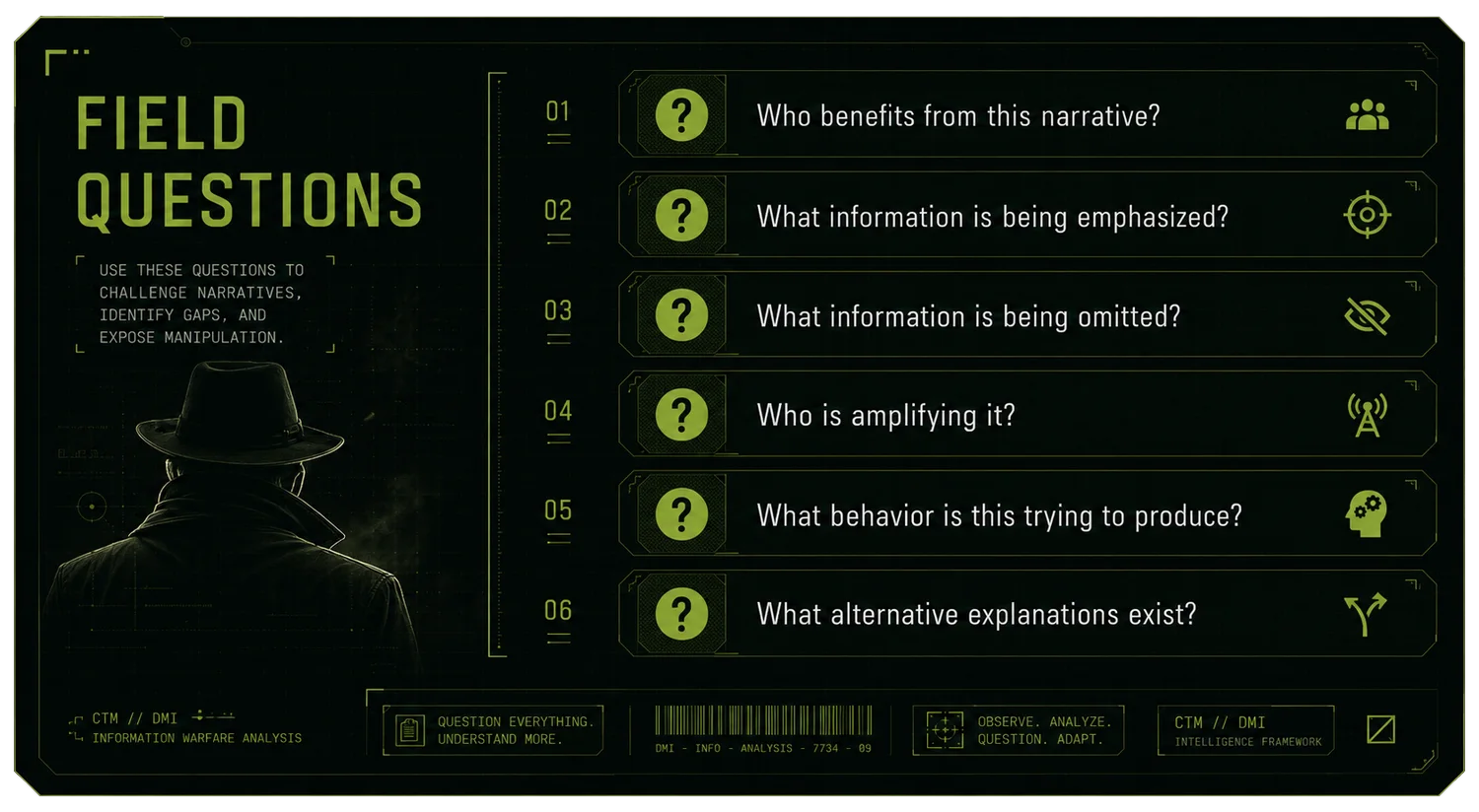
Use these questions to challenge narratives, identify gaps, and expose manipulation.
- Who benefits from this narrative?
- What information is being emphasized?
- What information is being omitted?
- Who is amplifying it?
- What behavior is this trying to produce?
- What alternative explanations exist?
FIELD NOTE
DMI ASSESSMENT
TEXT VERSION
Information Warfare is not inherently good or evil.
Every government. Every corporation. Every movement. Every political party. Every advocacy organization. Engages in it.
The objective is not to reject all narratives. The objective is to recognize when narratives are being used to shape perception.
Awareness is your advantage.