
THE COGNITIVE WARFARE LIFECYCLE
READ AS TEXT
01 · ATTENTION CAPTURE
Focus is pulled toward selected stimuli.
02 · COGNITIVE FRAMING
The issue is placed inside a mental frame.
03 · BIAS ACTIVATION
Mental shortcuts are triggered.
04 · COGNITIVE LOAD
Overload weakens clarity and increases reliance on simple answers.
05 · DECISION STEERING
Choices are narrowed and behavior is guided.
CORE DEFINITION & PRINCIPLE
READ AS TEXT
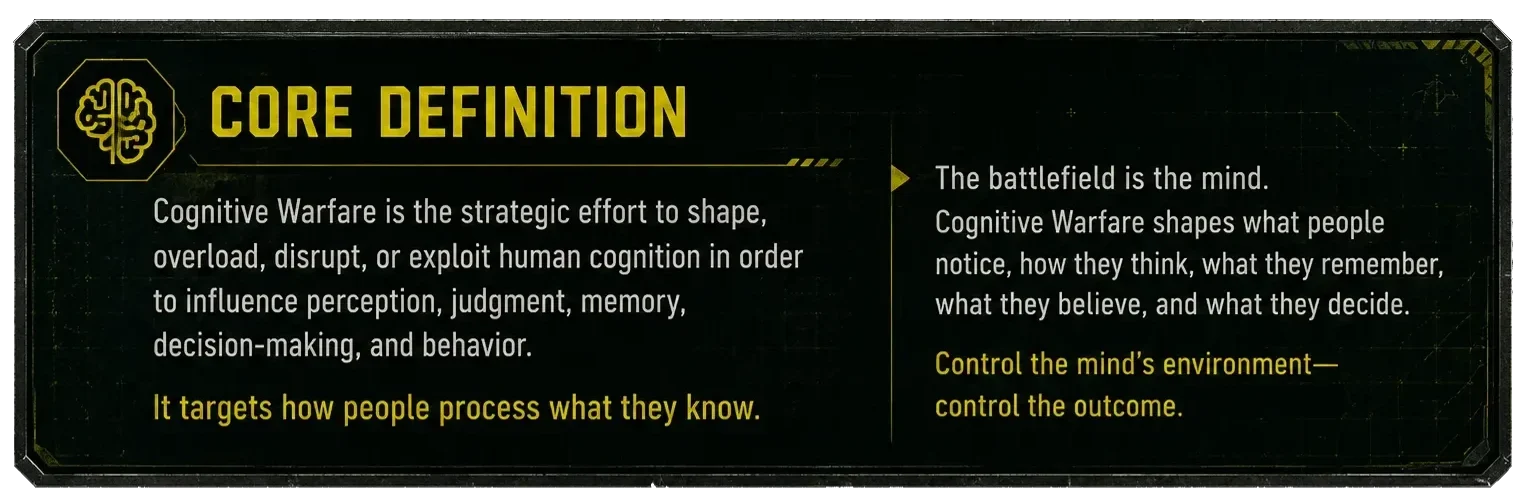
CORE DEFINITION
Cognitive Warfare is the strategic effort to shape, overload, disrupt, or exploit human cognition in order to influence perception, judgment, memory, decision-making, and behavior.
It targets how people process what they know.
The battlefield is the mind. Cognitive Warfare shapes what people notice, how they think, what they remember, what they believe, and what they decide.
Control the mind’s environment — control the outcome.
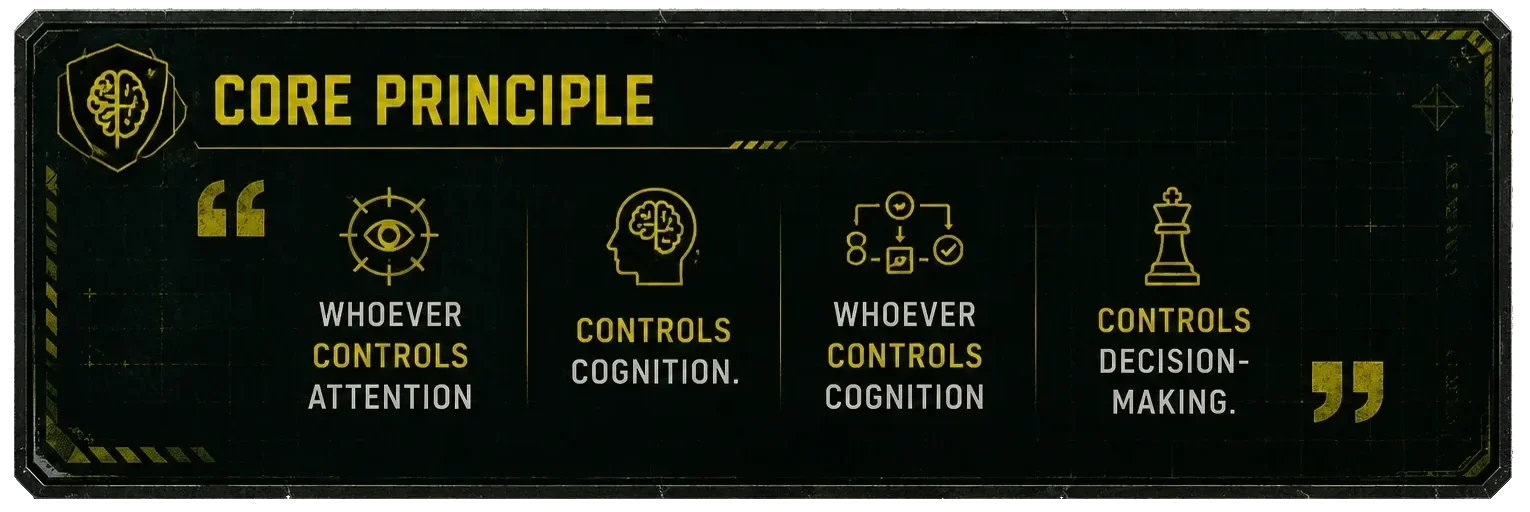
CORE PRINCIPLE
Whoever controls attention controls cognition. Whoever controls cognition controls decision-making.
MENTAL TARGETS
READ AS TEXT
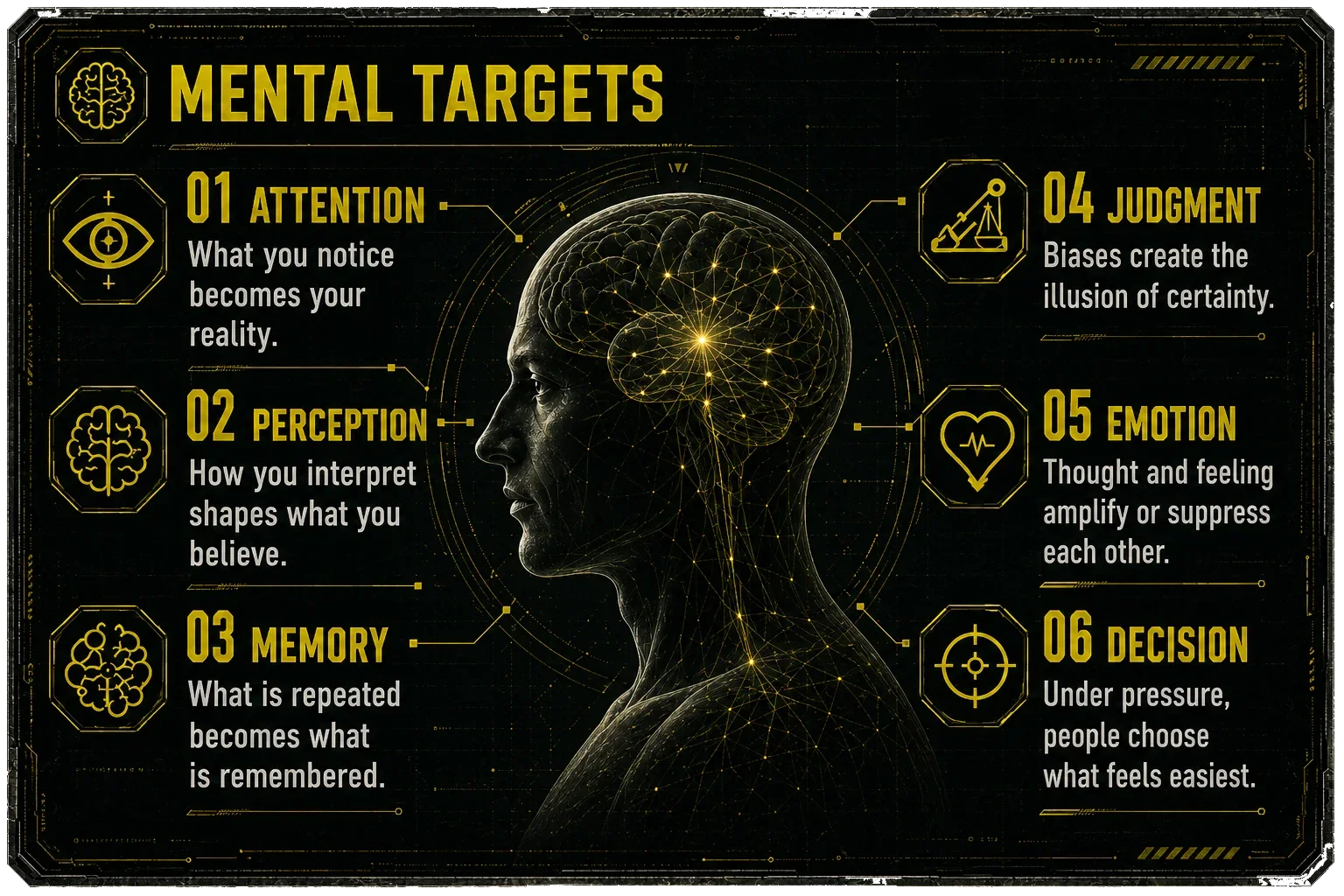
01 · ATTENTION
What you notice becomes your reality.
02 · PERCEPTION
How you interpret shapes what you believe.
03 · MEMORY
What is repeated becomes what is remembered.
04 · JUDGMENT
Biases create the illusion of certainty.
05 · EMOTION
Thought and feeling amplify or suppress each other.
06 · DECISION
Under pressure, people choose what feels easiest.
COGNITIVE BIASES EXPLOITED
READ AS TEXT
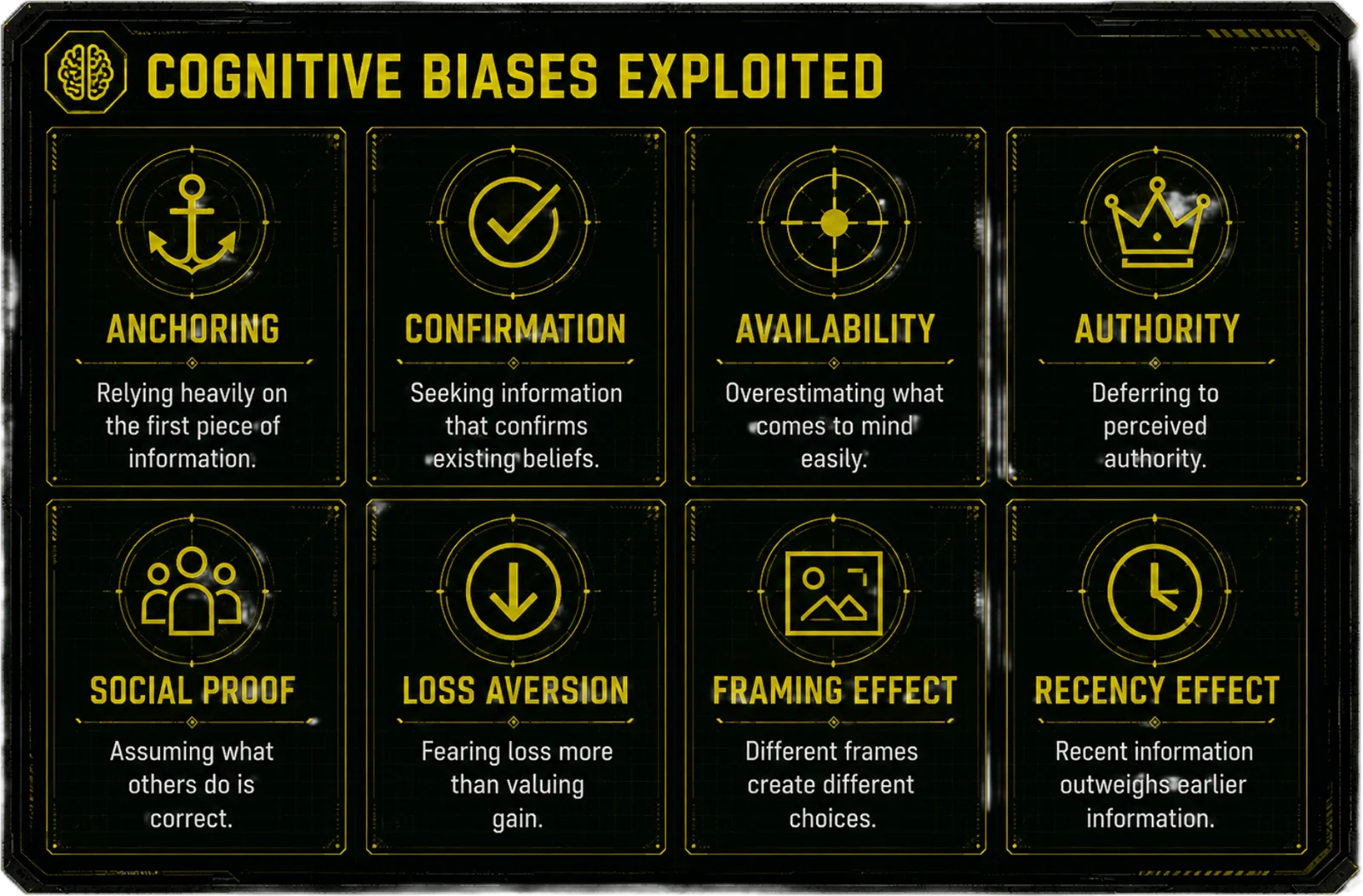
- Anchoring — relying heavily on the first piece of information.
- Confirmation — seeking information that confirms existing beliefs.
- Availability — overestimating what comes to mind easily.
- Authority — deferring to perceived authority.
- Social proof — assuming what others do is correct.
- Loss aversion — fearing loss more than valuing gain.
- Framing effect — different frames create different choices.
- Recency effect — recent information outweighs earlier information.
HOW IT SHOWS UP & OPERATIONAL OBJECTIVES
READ AS TEXT
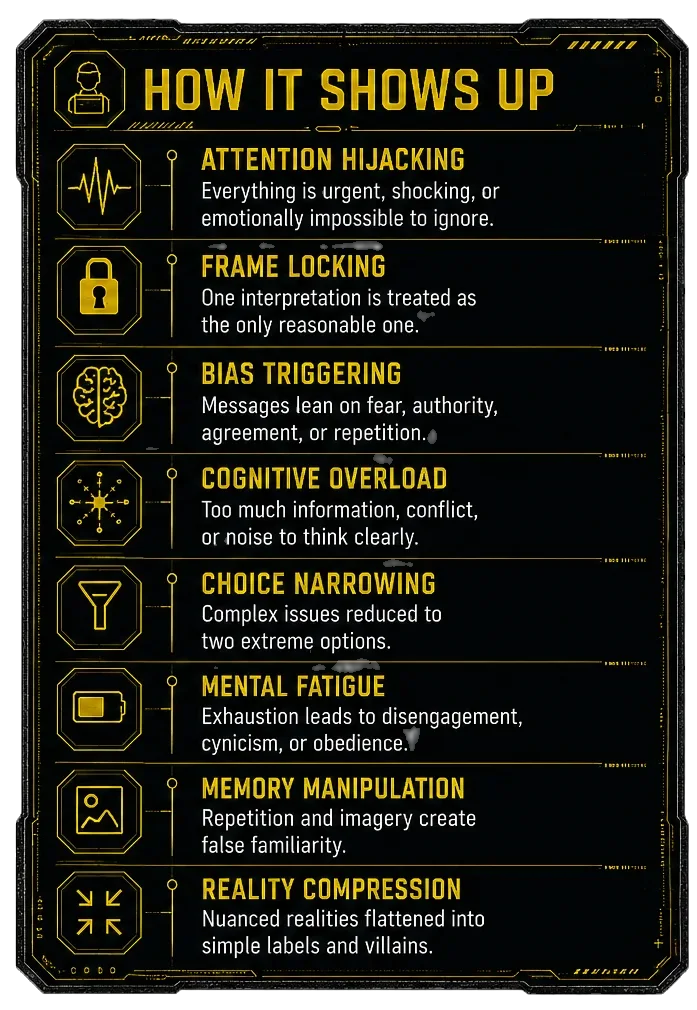
- Attention hijacking — everything is urgent, shocking, or emotionally impossible to ignore.
- Frame locking — one interpretation is treated as the only reasonable one.
- Bias triggering — messages lean on fear, authority, agreement, or repetition.
- Cognitive overload — too much information, conflict, or noise to think clearly.
- Choice narrowing — complex issues reduced to two extreme options.
- Mental fatigue — exhaustion leads to disengagement, cynicism, or obedience.
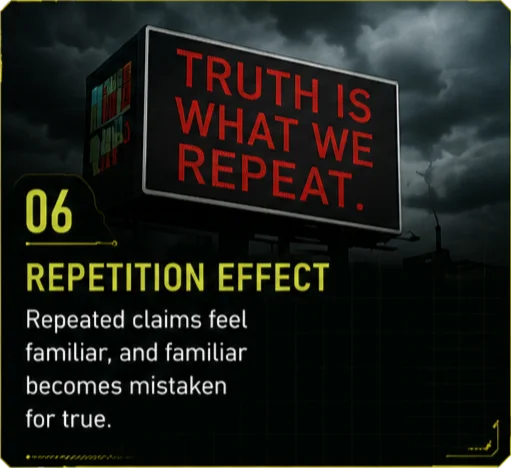
- Memory manipulation — repetition and imagery create false familiarity.
- Reality compression — nuanced realities flattened into simple labels and villains.
OPERATIONAL OBJECTIVES
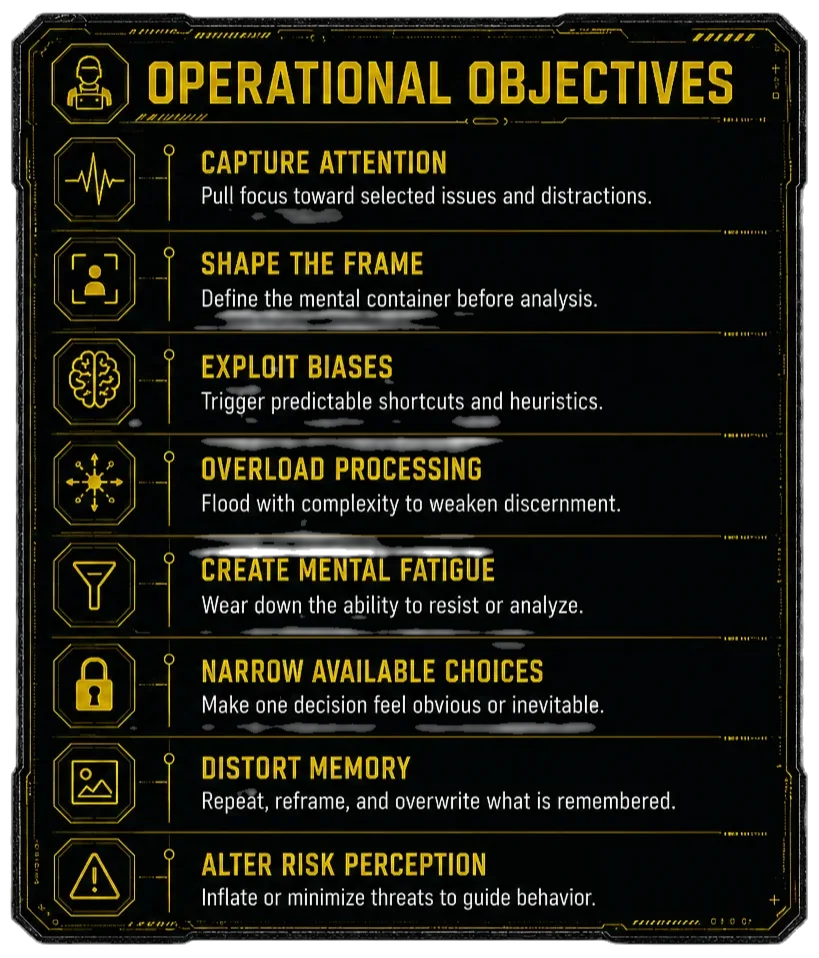
- Capture attention — pull focus toward selected issues and distractions.
- Shape the frame — define the mental container before analysis.
- Exploit biases — trigger predictable shortcuts and heuristics.
- Overload processing — flood with complexity to weaken discernment.
- Create mental fatigue — wear down the ability to resist or analyze.
- Narrow available choices — make one decision feel obvious or inevitable.
- Distort memory — repeat, reframe, and overwrite what is remembered.
- Alter risk perception — inflate or minimize threats to guide behavior.
CASE STUDIES
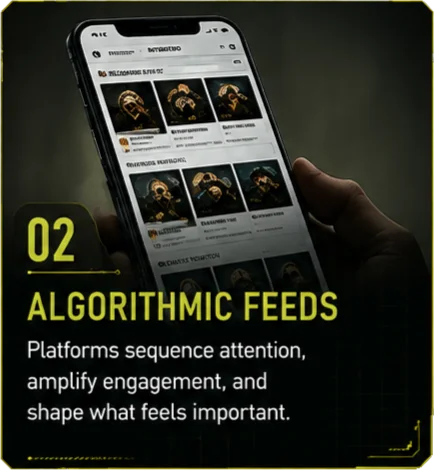
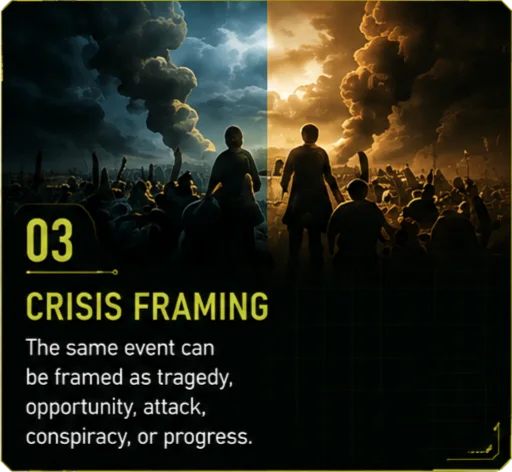
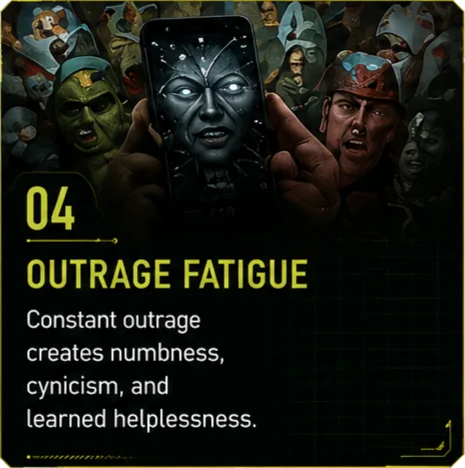
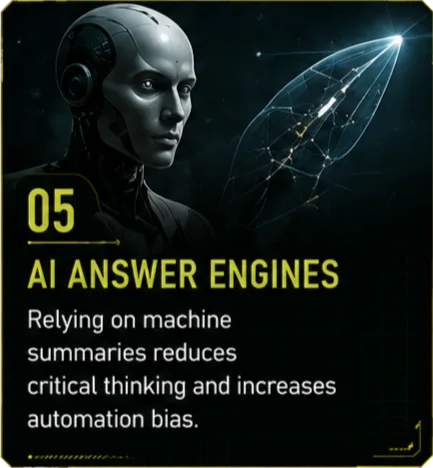
QUESTIONS TO ASK
READ AS TEXT
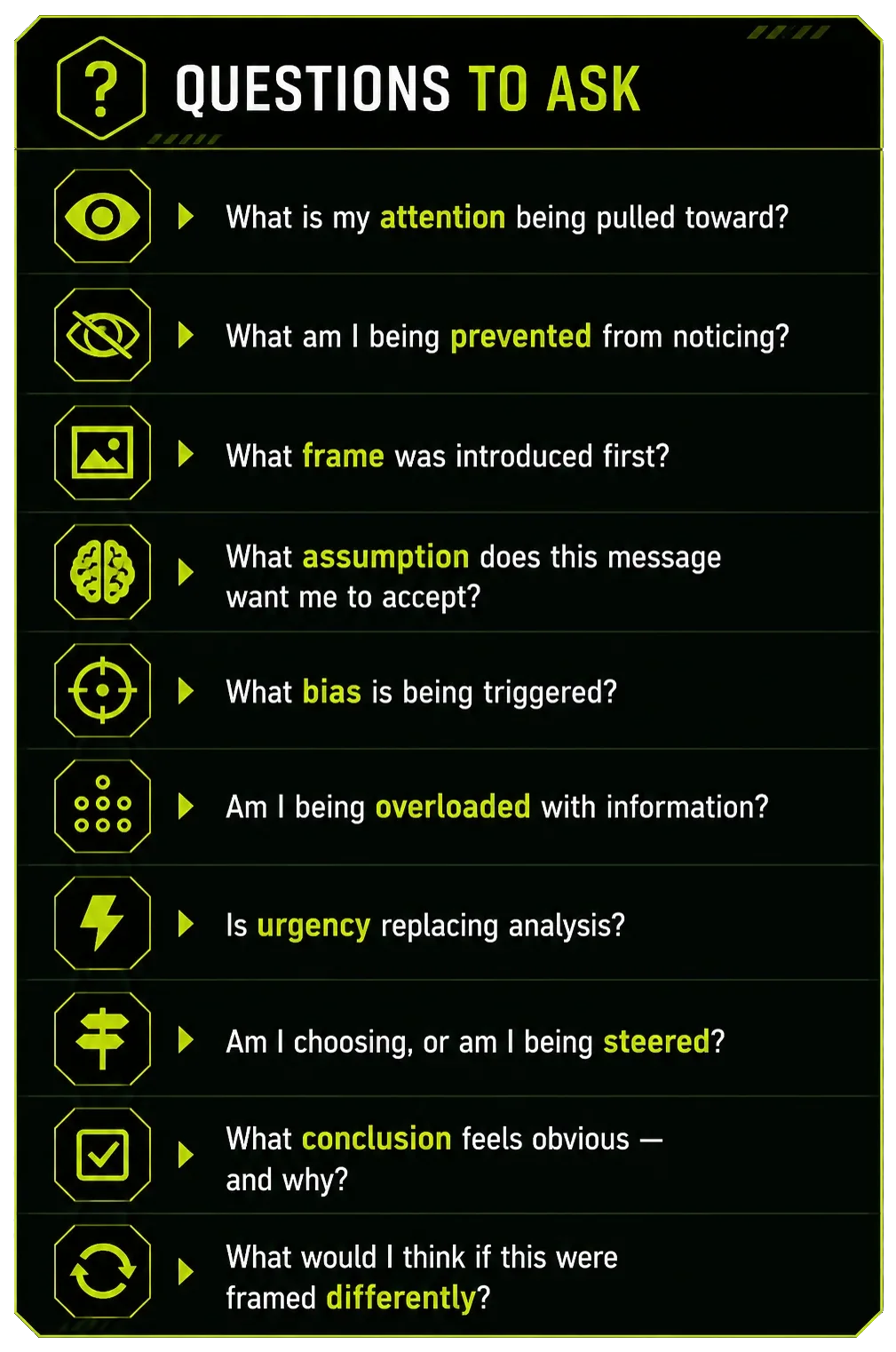
- What is my attention being pulled toward?
- What am I being prevented from noticing?
- What frame was introduced first?
- What assumption does this message want me to accept?
- What bias is being triggered?
- Am I being overloaded with information?
- Is urgency replacing analysis?
- Am I choosing, or am I being steered?
- What conclusion feels obvious — and why?
- What would I think if this were framed differently?
DMI ASSESSMENT
READ AS TEXT
DMI ASSESSMENT
Cognitive Warfare is powerful because it does not need to control every fact. It only needs to control the mental environment where facts are processed.
Control the mind’s operating system, and the target will deliver the outcome you want — willingly.
FIELD NOTE
“The mind does not process reality neutrally. It filters, frames, shortcuts, remembers, forgets, and fills in gaps. Cognitive Warfare exploits those filters before the target realizes a battle has begun.”